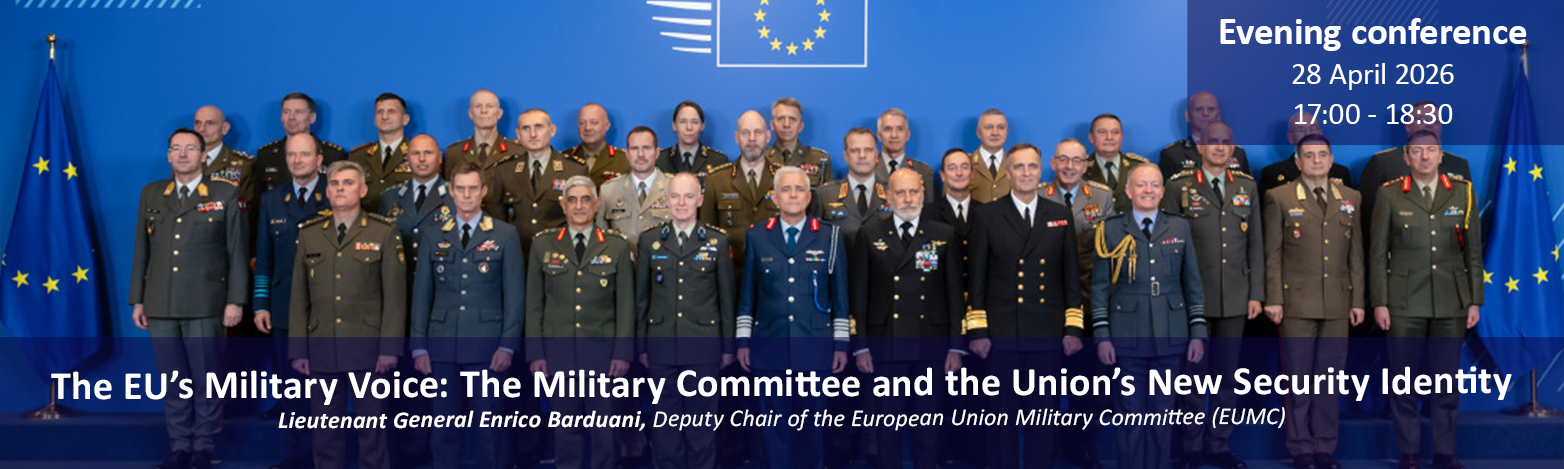
We are pleased to invite you to an evening conference organised on Tuesday 28 April 2026 from 17:00 until 18:30 by the Centre for Security and Defence Studies of the Royal Higher Institute for Defence.
Conference information
Date/Time
Starts
Ends
All times are in Europe/Brussels Europe/Brussels
Location
Materials
Extra information
Twenty-five years ago, the European Union Military Committee (EUMC) was founded, marking an important step in the gradual consolidation of a European defence. Occupying a central place in the Common Security and Defence Policy (CSDP), the EUMC is nowadays an essential element in the coherence and credibility of the European Union’s (EU) military action. The EUMC provides advice and recommendations to the Political and Security Committee (PSC) and exercises military command of EU-led missions and operations.
The EUMC contributes to the conduct of numerous civilian and military missions and operations in Europe, Africa and the Middle East. By ensuring coherence between political decisions and the way they translate into the operational domain, it allows the EU to act in a coordinated and credible manner. In particular, the EUMC plays a central role in the strategic orientation of EU military assistance to Ukraine, thereby ensuring consistency between adopted decisions and their implementation. As part of an intergovernmental framework where Member States retain control over their decisions, it favours alignment between means and priorities. This responsibility is carried out today in a profoundly transformed strategic environment that is marked by the return of high-intensity warfare on European soil, the proliferation of hybrid and cyber threats, and the need for greater readiness and resilience.
At a time when the EU deepens its ambitions in terms of readiness, structured cooperation and capability development, how should one take stock of the EUMC’s first 25 years in operation? How has the EUMC evolved with international crises and a changing CSDP? How does it contribute to the EU’s ability to act autonomously and in conjunction with NATO? What institutional and operational challenges lie ahead?
To answer these questions, we are pleased to welcome Lieutenant General Enrico Barduani, Deputy Chair of the European Union Military Committee.
This conference will be held in English at the conference room at campus Renaissance (entrance: rue Hobbema 8/Hobbemastraat 8, 1000 Brussels) on Tuesday 28 April 2026 at 17:00. Simultaneous interpretation in Dutch and French will be available on site. Please note that online participation will not be possible.
Registration is required by Tuesday 21 April 2026 at the latest.
Please note that access to the conference room is allowed until 45 minutes after the start of the event.